Where do Dragons Come From?
April 28, 2010
Dragons have been a important part of our culture since roughly 4000 and 5000 BC. We'll almost certainly never know if dragons actually walked the planet but one thing for particular is that they have left enormous footsteps in our imagination.
These fantastic reptilian/serpentine beings are seen in several different cultures, and each one of those dragons is as distinctive as the culture itself. Some inhabit the center of the planet, others live in the ocean. Some have wings, some don’t. Some have many legs, some have four. Some have nine heads, others have one. Some have five claws, most have fewer. Some are friends and others are enemies. All are a signof awesome strength and power.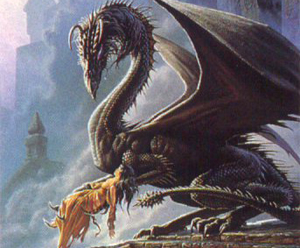
Cultural studies have suggested that the Assyrian and Babylonian goddess that personifies the sea, Tiamet, is the original reference to dragons. However, historians disagree about whether or not she really was a dragon, as we characterize it. It is not believed that most dragons throughout history can be linked to the Tiamat stories.
Perhaps the best documented dragons come from the Chinese philosophy. These characters are said to be made of parts from nine different animals: the body of a snake, talons of an eagle, antlers of a dear, head of a camel, belly of a clam, ears of a cow, soles of a tiger, 117 scales of a carp, and eyes of a demon. Dragons in Asian cultures are believed to be benevolent beings who run the water, including the rain, and have the power of change. In this sense, dragons are a force of the natural world and the universe as well as protector of Buddhist law. In this cultural system, dragons represent prosperity, fortune, and wisdom.
Western culture introduced us to a different kind of dragon: the malevolent, aggressive dragon. We read about these kinds of dragons in tales of Hercules and Beowolf. Jormungandr, also known as the World Serpent, comes to us from northern Europe in lore depicting a famous battle with Thor. West dragons are fierce creatures that protected (and horded) treasure and that heroes would have to slay to protect helpless maidens (acts that often ended in matrimony). These were fire breathing dragons, more like the modern American dragons we are familiar today. Battles with these horrifying creatures became representations of the battle between good and bad.
There are even references to dragons in the Bible--in Revelations, the devil is referred to as the "great dragon." Tales tell of people who are changed into dragons as punishment for greed. Others tell of dragons eating children and even the sun and moon, causing eclipses.
In modern day, dragons are the symbol of power, of supernatural abilities, and of protection. There are collectibles and images of dragons that are made particularly for garnishing your home and body. All sorts of dragons appear in the motion pictures from the good-natured imaginary buddy to violent adversaries. While we no longer talk about heroes opposing dragons, the creatures are still prevalent in our culture, for better or worse.
These fantastic reptilian/serpentine beings are seen in several different cultures, and each one of those dragons is as distinctive as the culture itself. Some inhabit the center of the planet, others live in the ocean. Some have wings, some don’t. Some have many legs, some have four. Some have nine heads, others have one. Some have five claws, most have fewer. Some are friends and others are enemies. All are a signof awesome strength and power.
Cultural studies have suggested that the Assyrian and Babylonian goddess that personifies the sea, Tiamet, is the original reference to dragons. However, historians disagree about whether or not she really was a dragon, as we characterize it. It is not believed that most dragons throughout history can be linked to the Tiamat stories.
Perhaps the best documented dragons come from the Chinese philosophy. These characters are said to be made of parts from nine different animals: the body of a snake, talons of an eagle, antlers of a dear, head of a camel, belly of a clam, ears of a cow, soles of a tiger, 117 scales of a carp, and eyes of a demon. Dragons in Asian cultures are believed to be benevolent beings who run the water, including the rain, and have the power of change. In this sense, dragons are a force of the natural world and the universe as well as protector of Buddhist law. In this cultural system, dragons represent prosperity, fortune, and wisdom.
Western culture introduced us to a different kind of dragon: the malevolent, aggressive dragon. We read about these kinds of dragons in tales of Hercules and Beowolf. Jormungandr, also known as the World Serpent, comes to us from northern Europe in lore depicting a famous battle with Thor. West dragons are fierce creatures that protected (and horded) treasure and that heroes would have to slay to protect helpless maidens (acts that often ended in matrimony). These were fire breathing dragons, more like the modern American dragons we are familiar today. Battles with these horrifying creatures became representations of the battle between good and bad.
There are even references to dragons in the Bible--in Revelations, the devil is referred to as the "great dragon." Tales tell of people who are changed into dragons as punishment for greed. Others tell of dragons eating children and even the sun and moon, causing eclipses.
In modern day, dragons are the symbol of power, of supernatural abilities, and of protection. There are collectibles and images of dragons that are made particularly for garnishing your home and body. All sorts of dragons appear in the motion pictures from the good-natured imaginary buddy to violent adversaries. While we no longer talk about heroes opposing dragons, the creatures are still prevalent in our culture, for better or worse.
Posted by Dragon Figurines. Posted In : Religion, Shopping, Culture, Society, Spirituality- >Metaphysical

